
Spain’s 18-year-old Crown Princess Leonor, heir to King Felipe VI, is quickly modernizing the monarchy. Her journey blends a sheltered upbringing, a global education, rigorous military training, and a distinctly modern leadership style. In 2025, she stands as one of the most intriguing and promising young royals in Europe.
Join Halp Us
Poised and thoughtful beyond her years, Leonor has spent her childhood away from heavy spotlight. As she stepped into adulthood, Spain watched closely as she emerged with confidence, discipline, and a strong sense of duty. Millions tuned in to see her preside over national ceremonies, take her military oaths, and deliver speeches that showcased both clarity and maturity. After years of royal scandals under her grandfather, many Spaniards view Leonor as a breath of fresh air, someone who symbolizes renewal and a more ethical future for the monarchy.
Today, the young princess is redefining what it means to be a royal heir in a new era.
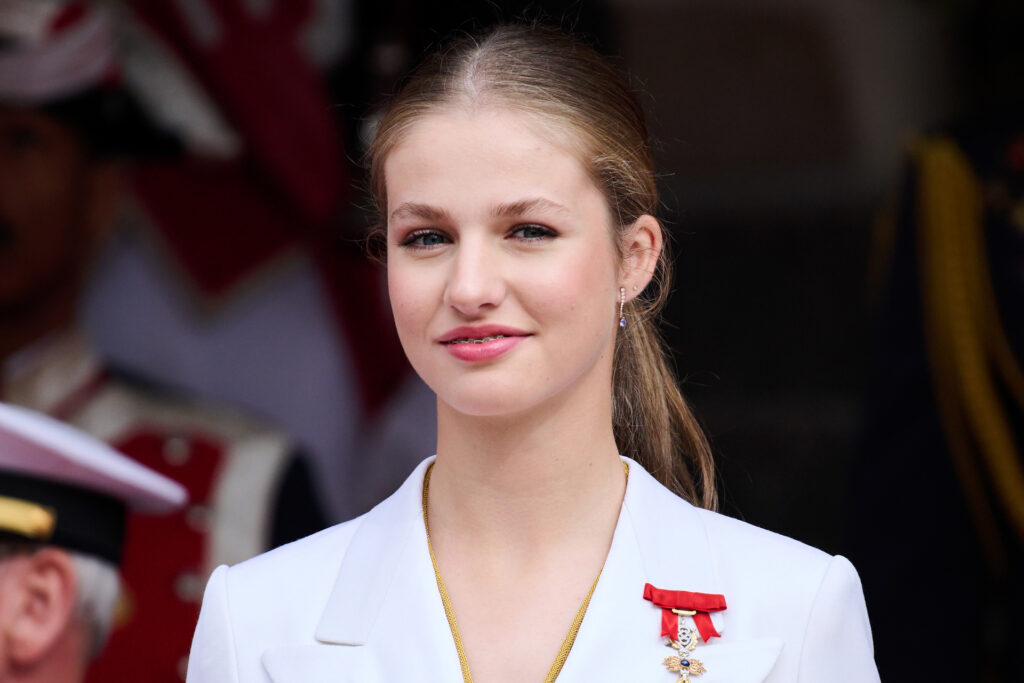
Early Life and Public Image
Born in October 2005, Princess Leonor grew up in a modern, education-focused royal household. She attended Santa Maria de los Rosales School in Madrid, where she excelled academically and cultivated a strong interest in languages. She is fluent in Spanish, Catalan, and English, and has studied French, Arabic, Basque, and even Chinese.
Throughout her youth, Leonor appeared in public only a few times each year. This careful protection led to what the press later called “Leonormania” when she finally began to take on more official roles.
Her popularity grew rapidly after she turned 18. Spaniards admired her warm smile, disciplined demeanor, and sincere approach to responsibility. Her teachers described her as intellectually curious, respectful, and passionate about understanding people from different backgrounds. As public visibility increased, so did admiration. Her appearances on national occasions, such as marching beside her father on Spain’s National Day, drew record-breaking television audiences. Each new event reinforced her growing reputation as a relatable yet dignified future queen.
Global Education and Its Symbolism
Princess Leonor’s schooling reflects Spain’s commitment to preparing her for global leadership. After completing her early education in Madrid, she moved to Wales to study at the prestigious United World College Atlantic, where she earned her International Baccalaureate diploma.
The school gathers bright young people from across the world, fostering global citizenship, teamwork, and service. Leonor studied alongside students from dozens of cultures and backgrounds, including peers from other royal families.
Also Read: How to Earn Money Online.
Her education abroad sends a strong message: Spain’s future monarch has firsthand experience living in a diverse international environment. This global perspective sets her apart from past Spanish heirs, who were typically educated exclusively at home. Leonor’s schooling abroad not only strengthened her language skills but also exposed her to diplomacy, multicultural cooperation, and international problem-solving.
In many ways, her education symbolizes a new, outward-looking vision for the Spanish Crown.
Click Me Pic
Rigorous Military Training: Army, Navy, and Air Force
One of the most intense and tradition-rich aspects of Leonor’s preparation is her three-year military formation, following the same path as her father. Spain requires its future monarch to be trained in all three branches of the armed forces.
Army – Zaragoza
In August 2023, Leonor began her journey at the General Military Academy in Zaragoza. She trained alongside fellow cadets, participated in drills, attended classes, and received her officer’s sword. She later swore her oath to the Spanish flag in a highly watched ceremony. Her discipline and sense of duty impressed both the public and the press.
Navy – Marín and the Elcano
For her second year, Leonor joined the Naval Military School in Marín. She then embarked on a five-month voyage aboard the historic tall ship Juan Sebastián de Elcano, learning navigation, teamwork, and seamanship while visiting international ports. She also trained aboard a modern frigate during naval exercises. Her dedication earned her Spain’s Grand Cross of Naval Merit.
Air Force – Murcia
In 2025, she will begin her training at the General Air and Space Academy, where she will learn aviation fundamentals and leadership within the Air Force. By completing this rigorous journey, she will earn ranks in all three branches, making her one of the most comprehensively trained heirs in Europe.
Throughout her service, Leonor has insisted on being treated like any other cadet. She uses both her parents’ surnames on her uniform, refuses cadet pay, and represents modern values such as gender equality and merit-based work.
Spain’s defense officials openly celebrate that the country’s future commander-in-chief will be a woman. Her training sends a powerful message: the Spanish monarchy is evolving.
Leadership Style and Diplomatic Potential
From the beginning, Princess Leonor has demonstrated a leadership style marked by empathy, humility, and intelligence. During her 18th-birthday oath ceremony in parliament, she maintained a professional and solemn presence, yet her warm smile revealed her youthful charm.
Her teachers describe her as curious, compassionate, and eager to listen—qualities essential for diplomacy. She speaks multiple languages, understands Spain’s regional diversity, and has already represented the Crown at several cultural events.
Also Read: Best Websites for Online Income in 2025
Comparisons are drawn between Leonor and other young heirs like Princess Elisabeth of Belgium and Princess Ingrid Alexandra of Norway. Like them, she breaks stereotypes by embracing military roles traditionally reserved for men. Spanish commentators have even compared her popularity to the early public appeal of the younger British royals.
Leonor’s combination of modern education, disciplined training, and warm public presence sets her apart as a balanced future leader.
Breaking Traditions in a Patriarchal Monarchy
Princess Leonor’s position challenges Spain’s traditional rules. The country still has a succession system that favors male heirs, meaning that a hypothetical younger brother would outrank her. Despite this outdated law, Leonor stands as Spain’s first female heir in nearly 200 years.
She is also redefining royal norms through her behavior and choices. Using both her mother’s and father’s surnames on uniforms reflects a modern approach to identity. Her military training, international education, and visible work ethic contrast strongly with past royal lifestyles.
Spain’s leadership highlights her rise as a milestone for gender equality. A future queen commanding the nation’s armed forces marks a historic shift.
A New Generation of European Heirs
Leonor joins a broader wave of young female heirs across Europe. However, her path is unique. Few heirs combine an international education, full tri-service military training, and a rapidly rising public profile.
While her peers focus primarily on diplomacy or public engagements, Leonor’s preparation is intensely hands-on. Her journey speaks to a monarchy trying to rebuild credibility and reconnect with a diverse society.
Across Europe, she is viewed as part of a modern generation of royals—educated, socially aware, and prepared to take on symbolic roles in a changing world.
Projected Impact on Spain and the Monarchy
Many analysts believe Princess Leonor is central to the monarchy’s future stability. After years of controversy, her popularity offers the Crown a renewed sense of hope. Her disciplined public image appeals to both traditionalists and younger Spaniards.
Her constitutional oath at 18 reaffirmed her dedication to defending citizens’ rights and regional identities. Observers interpreted this as a clear sign that she intends to be a modern monarch who respects Spain’s democratic values.
Leonor’s rise has brought positive media coverage at a time when the monarchy desperately needed it. Some commentators suggest she may be Spain’s best chance at restoring trust in the institution.
As she continues hosting cultural, scientific, and humanitarian programs, she demonstrates leadership even before taking the throne. Many expect her to eventually champion global issues such as education and youth empowerment.
Conclusion
Princess Leonor’s journey is just beginning, but she already stands out as a symbol of renewal for Spain. With a rare blend of discipline, empathy, education, and modern values, she is reshaping the monarchy from within.
Her story reflects a monarchy attempting to evolve—bridging tradition with transformation. Spain sees in her a hopeful path forward, and as she continues her training and public duties, she grows ever closer to becoming a queen who understands both her country’s past and its future.
Princess Leonor represents exactly what Spain needs its next monarch to be: steady yet modern, grounded yet globally aware, and committed to serving her people with dignity and purpose.